Thoughts for Days 23 & 24: Your Inner-Artist is a Child & Don’t Flake

Today’s two thoughts are related.

1. Your Inner-Artist is a Child.*

*If you are one of those people who hates children but likes puppies, please free to think of your inner-artist as a puppy instead.

2. Don’t Flake (on your child).

Okay, so number one comes from Julia Cameron’s philosophy on being an artist.  She says that you need to treat your inner-artist (the writer inside) like a child.  Like a child, your writing needs to be nurtured, not just yelled at sometimes.  You must find ways to make corrections without hurting the child too much.  You are aware that you can abuse the child and that the child can grow up all messed up because you let someone else come too close to and abuse it. You have to protect the inner artist child. You also need to have fun with the child. You are aware that your child needs time to play. You need to let the child be funny sometimes and serious at other times. You are also aware that sometimes your child is crabby but that time-outs are a little more civil than beating the child up for punishment.  You must feed the child.  You must give the child a nap to reboot. 

Most of all, you acknowledge that your child is growing–it’s not right now where it is going to be one day.

Once we have that idea down, it’s really important that we learn how not to flake on this child.

This is thought two, by the way. 

Maybe we shouldn’t make promises to our inner-artists.  Maybe we shouldn’t say, “Just you and me, we’re going to work together all day Saturday” if we are going to something else all day–like play with Facebook instead. But the better case scenario is that we teach the child that we can make promises and keep them.  That teaches the child to trust what we say.

Imagine if you had a child who was waiting for the two of you to interact and you were just getting drunk every time you said you were going to hang with them, or just hanging out with your friends all the time instead, saying, “I’ll get to you next week! Next week! I promise!”

I have a special sensitivity about flakes, which comes from the facts that a) I’ve dated a couple and they drove me up the wall and b) my dad taught me to hate flakiness as a profound statement of disrespect.  My dad is always, always on time.  He was also a fireman for thirty years.  In Detroit.

Anyway, in grad school it’s really very easy to be a flake.  We all, from time to time, say we’re coming to something and do not show.   Maybe we just forgot, but we probably didn’t.  We’re just too busy and stressed and too lazy to give the host of the party a heads-up that no, we’re actually not going to make it over.  Again, thanks to my dad, this drives me up the wall.  I hate feeling like anyone is wasting my time.

(I have learned, however, that bringing a book wherever you go is a really good antidote to feeling like your time is wasted while you’re waiting for someone or something to happen.)

I do my best not to flake.  I really do.  I try not to say I’m coming unless I know I can be there.  I try to apologize to those whose readings I’ve missed.  If I change my mind about whether I can go to something, I try to let the host know as soon as possible.  If I have to pull out of an event, I try to set up an appointment right away.  I really try to be where I said I was going to be at the time I said I was going to be there. 

Unfortunately, I do have a gene from my mother’s side of the family that gives me a poor sense of time. Great sense of rhythm, poor sense of time.  Several of us on that side are naturally late to everything–especially the ones who dedicate more time to their artistic side (we are all artists on that side of the family, although not everyone puts that art into practice. Ebbs and flows for most of us.) 

It’s like a war against my genes inside–I feel awful for being late but then, ah! I can’t help it! I’m late! 

It’s stressful.

All of this is to say that I had a pretty humbling experience this week when I came down hard on someone for being a flake and then realized that I am a flake to myself.  To promise myself I’ll do something (like start jogging this summer and quit smoking, or to stop eating sugar because it destroys my mind and makes me crazy) and then not do it is the same as flaking on myself. 

I promise myself I’ll write and then I don’t.

If you’re a writer, I think you understand what if feels like to neglect your writing.  It’s more than guilt.  It feels like this kid is inside:

He’s ready to go. He’s got his cape on and everything.

Our inner artist children are also probably quicker to forgive us than most grown-ups.   If we do neglect the child, we can apologize, move on, and recognize that our pattern of behavior is deeply going to affect the child.

But we can change the pattern. We can always change the pattern.

Thought for Day 20: The Game

I am a day behind in my writing thoughts but I wrote two today to catch up.

Here’s the thought for yesterday:

Know what game you’re playing and know the rules.

This thought comes from this sermon Iyanla Vanzant preached called “Playing the Game”:

The speech is full of great metaphors about life from baseball and football.  “You have to get all the way up the field,” and “You can’t get the house and the jaguar if you’re only on first base,” etc.  The essence is, know what game you’re playing and know the rules.  If your game is to publish a novel, you have to get focused on “where you’re going in order to get there…”  A rule might be that when you’re trying to write, you can’t have Facebook open in your browser.  It might be that you have to write for two hours a day.  It might be that you have to accrue a team of allies.

You have to get educated.  You have to figure out how the game works.  When it’s time to find an agent, you have to figure out the rules to that part of the game.  Know where you are in the game.  If you’re on first base, don’t expect the celebration of a home run.

If you write science fiction, there are different rules to writing horror.  You know this.  I get a lot of complaints from my friends who write in genres that those of us (like me) who don’t write in genres take them less seriously. First of all, I do write in a genre, it’s called literary fiction, I guess.  I have trouble with that word “literary” though, because there are tons of literary romances out there. There is crossover, but our job is to figure out what game we’re playing.  I am currently writing a literary ghost story.  It has different rules than the book I thought I was going to write–a transnational epic about human trafficking.

Do know that one game is not more valuable than the other. If anyone tells you that you’re style of writing, or your genre, or your interests, is less valuable, they are talking from a POV of taste preference, not capital T Truth.

That said, do know that the games share a lot of the rules.  Don’t worry about whether or not other people think your kind of writing is valuable.  Just play the game that makes you the most excited.

Thought for Day 19: Embrace Challenge

It’s Malcolm X’s birthday and I’ve been thinking about him since this morning. His life’s story has had a pretty big impact on my white-girl-growing-up-in-Detroit narrative.  I think his words have a lot to teach us about writing and living. I mean, they have taught me a lot.

One of the greatest gifts anyone ever gave me was the assignment to read The Autobiography of Malcolm X in high school. I think it was my senior year but I can’t remember.  Could have been my junior year.  I had the same teacher for both.  I was one of a handful of white students in a predominately black school.  We watched the Spike Lee film in that same English class and there’s this scene in the movie (and if I remember, in the book, too) where this white woman comes up to Malcolm and asks what she can do help his cause. He looks at her directly and says, flat-out, “Nothing,” and walks away from her.  She is flabbergasted. Then a bunch of eyes fell on me for my reaction. Fell on me and on the other white girls in the class.  I can’t speak for the other white girls, but I know I was devastated when I read and watched that.

That moment, and the book in general, has taught me a lot about compassion.  It forced me to spend hours with words that challenged me and made me uncomfortable; and this is a big part of what compassion is, I think: the willingness to engage with a different perspective.

If you know the book, you know it is about transformation. Granted, I read it a long time ago, but I think I remember that Alex Haley met with Malcolm X at various points in his life for him to articulate the story.  Between meetings, Malcolm’s opinions changed drastically.  Each moment in the book is like a blazing light in a different color.  Blazing, because Malcolm X is so convincing, so articulate, so courageous in his word choice.  Each argument mesmerizes the reader.

The book ends up being a testament of a person who was always hungry for the truth, who was always ready to stand up and serve the truth as he knew it at various moments of his life.  This dedicated search required that he learn new information from time to time. He never stopped looking for the truth and as a result, the truth changed for him.

Malcolm X’s story is the story of what happens when a person believes something as hard as he or she can believe it, gets more information, and actually has the rare courage to change that belief.   Not only change the belief, but speak out for that new belief.

Okay, so here is where our writing comes in:

I already wrote an entry earlier this month about how a writer needs to be open to transformation, and so today’s writing thought takes it a step back from that to say that in order to be transformed, we have to allow ourselves to sit in the room and listen to people who disagree with us. We have to engage with our characters when their story makes us uncomfortable–goes to a place we don’t want be. This is more than tolerance—tolerance is sitting in the room with a different perspective without allowing that perspective to change us.  Tolerance is cold and has little use for a writer.

Instead, we must learn to be uncomfortable, we must learn to acknowledge another person’s perspective in such a way that we let it transform our own perspective. Meanwhile, we also have to know when to speak up. It’s a hard balance.    It’s probably the most challenging aspect of being an artist.

You might be asking, why? Why do we need to embrace discomfort?  Because great writing, I believe, involves a lot of tension and transformation.  You must have both of these things to tell a great story.

Thought for Day 17 & 18: Don’t Fake It

Authenticity is one of my favorite words.  The people I get along with most are the ones that I feel like I don’t have to hide anything from.  I don’t like hiding things.

Lucinda Williams, that blues-americana goddess, is a great example of artistic authenticity.  If you want to “hear” authenticity, hit the play button.

I just want to live the life I please/I don’t want no enemies/I don’t want nothin’ if I have to fake it.

You don’t have to fake it, Lucinda. You prove that very well.

And so it goes with writing.  Especially with writing fiction, which calls us to be more authentic than ever because we have to persuade the reader that the story they are reading is true.  Not real, but true.  There is a distinction and it’s our job to search out what that distinction is, exactly.

Part of being an authentic writer is to be honest with ourselves about where our story is at.  We can’t fix its problems if we don’t acknowledge them.  This means that when we get a critique, we allow ourselves to be pissed for a few hours/days/months until that negative energy rolls away and leaves behind a constructive thought we can take to the revision.

It also means that we are honest with our drafts about the paragraphs we’ve stuck there as place-holders so we can bypass the hard scenes to write–the ones that make us uncomfortable.  Often those paragraphs are full of inauthentic sentences.

If you’ve taken a fiction workshop, you’ll know that a lot of time is spent on logic.  Our colleagues scan our work with a BS radar and look for places where it seems like we’ve bent the truth to get through a scene that we don’t feel comfortable writing. Writing takes courage, folks.  Meanwhile, our colleagues mark our drafts for the sentences that don’t convince them. (Robert Olen Butler, by the way, is a genius at this. I got to take a five person workshop with him here at FSU and he would go through our drafts, sentence by sentence, and point out where the words lost their contact with authenticity. It’s on the shortlist for best workshop I’ve ever taken.)

Part of the fiction writer’s job is to convince the reader, and that doesn’t come from learning how to lie real well.  It comes from being as authentic as possible on the page.

Oh, and being authentic off the page is good practice for nailing authentic sentences.

Thought for Day 16: Keep the Drama on the Page.

This was my favorite part of Julia Cameron’s THE RIGHT TO WRITE (which I am about to finish after I write this post). She says:

For a writer, personal drama is the drink of creative poison.  For a writer, the willing engagement in power struggles is an act of creative sabotage

(p. 41).

This is the truth.  We are living in world of crazy people–all people are crazy. It’s true! All people are self-absorbed. Especially artists. Especially talented ones. You included. Me included.  That doesn’t mean we have to contribute to the world’s craziness.  Our writing can and should bring order to this–help us process and perhaps contribute to the eradication of all hate and harm by acknowledging hate and harm, by getting a handle on it.  If you must act on drama, journal about it.  Save it for your characters’ conflicts.

We don’t have a choice about whether drama will get into our lives but we can learn how to deal with it before it takes over us and prevents us from writing. Here are three ways we can keep drama from interfering with our work:

1. Do our best to avoid it. 

We can start by being careful how we handle other people–especially in romantic/physical situations.  In all of our relationships, romantic or otherwise, avoiding drama looks like keeping other people’s best interests at heart. Pretty simple.  This doesn’t always work, though. People lie. People keep important information from us.  Even so, a lot of drama can be avoided if we go at the world with our best intentions.

2. Be aware of our own power trips.

Writing can help us acknowledge when we feel powerless.  Sometime we will. This is just going to happen.  But by acknowledging this, we can prevent ourselves from using whatever power we have  to harm others.

Do harm to your characters instead. It will make for a much more interesting story.

3. Rise above criticism.

People are going to say mean things to us, or mean things about our writing. Not all criticism is constructive.  But an important aspect of being a writer is having a thick enough skin to sort through criticism and pull out the constructive stuff.

4. Remember that people are time and energy.

Avoid the ones that waste your time and energy.  That doesn’t mean you have to be mean to them.  (See #1). Be respectful.  Love everyone. Even so, loving everyone doesn’t mean handing over your time and energy for them to sabotage it. Sometimes the most loving thing you can to for a person is to leave them alone to their own devices.  Loving someone sometimes means acknowledging that you can’t fix them. It means letting them learn how to fix themselves after you’ve treated them with your best intentions. Ultimately,  you choose who you spend time with and who you think about.

Got drama? Shake it off. Bring it to God, if you are prone to do such a thing. Acknowledge when you need to ask for forgiveness from folks.  Don’t expect anyone to apologize to you when they have hurt you. No matter what, know that you are bigger, more complex, more beautiful than whatever is trying to get in and sabotage your work.  Ultimately, we decide what to worship (what to give power to).

For more information, listen to David Foster Wallace’s speech to Kenyon College:

Thought for Day 13: Embrace the Waste

I don’t know about other MFA fiction graduates, but I think the most daunting thing about not being in a workshop, and not having a committee waiting on a draft, is the fact that we have no deadlines. I’ve already written about this (Thought for Day Three), but today I’m thinking more about how the lack of having a deadline changes my attitude towards writing.  Here’s my thought: embrace the waste.

(Just like it says on the title for this post!)

This thought came to me after reading Dorothy Allison’s interview in a book called Novel Ideas.  Allison talks about different tricks she uses in taking a fresh look at her manuscript for a revision.  She puts it down for a year.  She writes entire sections in a different perspective (character or narrative perspective, like from first to third).  She does a whole lot of writing and then tosses that writing away–none of it goes into the final draft.

I will remember my committee-chair (Elizabeth Stuckey-French) the most by one phrase she loved to say, again and again: “Try it and see where it goes.”  This is a lot easier to do when we don’t have a deadline approaching. (ESF taught a really good class about novel writing that I was super lucky to take. In fact, that class is why this Novel Ideas book is on my shelf.)

Maybe other people had different experiences as students, but I wrote with a lot of pressure to get it good the first time.  Not get it right, but get it good.  Get it good enough so it wouldn’t get slaughtered during workshop. I taught 45 students and was often taking three classes at a time while I was completing my MFA. I didn’t really have time to waste a lot of pages trying things.

Writing while a student has shaped my perspective in a bit of an unpractical sort of way: I feel like I have little sense of how much work actually goes into completing an entire book, especially a book that I want to be not only right and good, but amazing. I think a big part of writing an amazing book is allowing ourselves to try things and see what happens.

Let no possibility go unexplored.

This post, I suppose, is sort of a confession.  I suspect that if I were a better student (and I suspect that if I didn’t take the teaching so seriously, which I just could not figure out how to do), I would have made more time to waste pages.  Now, the ability to just write a bunch of pages for the mere act of discovery sounds like a tremendous gift.  Nobody’s waiting on my novel (except my close friends and family).  It feels luxurious.

It’s also really, really scary.

Being open to possibilities takes a lot of courage.  This is why, I believe, fundamentalism is closely related to fear. Any kind of fundamentalism, religious or secular.  Chin up, writers. And by writers, I mean me. Time to march into the unknown.  And by the unknown, I mean, the possibility of making a discovery while wasting a bunch of pages.

And waste is probably the wrong word.  Each sentence we write is productive, because it means, simply, that we are writing.  The only waste a writer has is the sort of muck/guilt/fear that piles up after not having written in a while.

Recommended Reading: Novel Ideas (Second Edition) by Barbara Shoup and Margaret-Love Denman, University of Georgia Press:  2009

Thought for Day 11: Pay Attention.

Woodypayattention
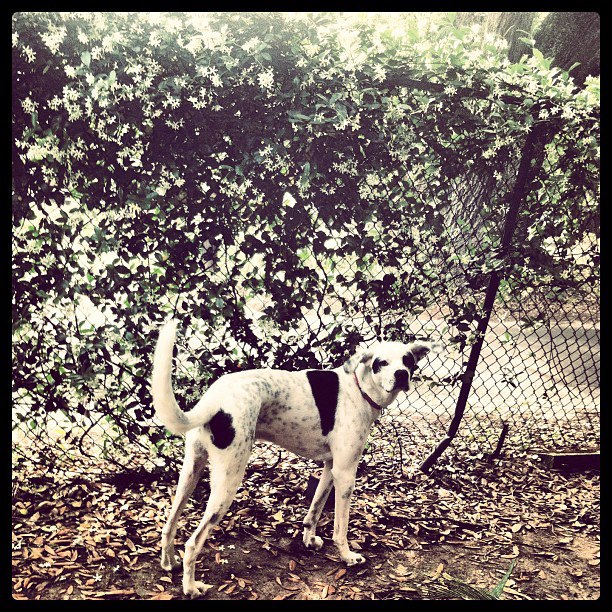
This is my dog, Woody. He’s really good at paying attention.

I just finished The Day of The Locust by Nathaniel West, which is an example of telling a story through great details  (in this case, of faux-everything-Hollywood).

Next he came to a small pond with large celluloid swans floating on it. Across one end was a bridge with a sign that read, ‘To Kamp Komfit.’  He crossed the bridge and followed a little path that ended at a Greek temple dedicated to Eros.  The god himself lay face downward  in a pile of old newspapers and bottles.

–Chapter 18, page 126.

The book is full of descriptions like this: semi-cold language with stark images to carry the emotional weight.  The protagonist (Tod Hackett) is so out of touch with his feelings. He’s got strong feelings but no clue what to do with them.  He sort of reminds me of Pete Campbell from Mad Men in that regard.   It’s descriptions like these that really get the job done in terms of portraying the amount of despair this dude actually has in his life.

Strong sense of setting is of particular importance to me in my own writing.  Stories usually come to me first, not in terms of “who” (like we’re trained, usually, to start with), but more in terms of “where.”  I get a place, and then I try and figure out who is in that place and what they want.  I cannot separate people from their places.  I am only sharing this in order to acknowledge the fact that not every writer works this way and I get that.

Even so, I think we writers can benefit from emphasizing place in our stories because in order to do that, we have to train ourselves to pay attention to our surroundings.  Paying attention is an enormous part of being a writer, of course.  Listening, we hear about often.  Watching, not so much.  Or maybe I’ve just not encountered too much from writers about the importance of being watchful. Maybe being watchful just sounds creepy? Whatev.

I have a grandmother who is a painter. She painted until she was near 90, or maybe she painted after she was 90, I can’t remember–she actually might have started up again. It’s been a long time since I’ve been home.   She is pretty awesome for a lot of reasons but one of them is that when I used to drive her places, I’d be telling her about something and then she would interrupt me to point out cloud formations, or the amount of birds hanging out the telephone wire.

Now I’ll admit, I don’t pay attention as well as she does.  I think it was Flannery O’Connor who suggested writers take drawing lessons. That is a great idea.

(Ooh! If you know me and would like to buy me a gift, I would love another copy of Drawing from the Right Side of the Brain… I left mine in Bangkok with a friend because it was too heavy to take back to Detroit.  My birthday is coming up, you know. :D)

And I think it was Natalie Goldberg who offered the following meditation for connecting to our surroundings:

While traveling–walking, driving, riding along as a passenger–pick a color, say red. Next, note all the objects you see in red.  

So simple, right? But it definitely works wonders for helping me connect to a place. I did this a few times while I was working and living in Thailand and I recommend it to anyone traveling.  It’s especially useful when you are tired of wherever you are, or homesick, or just don’t want to be in a place. It cultivates appreciation, however bland a way it seems.

This year, I came up with a point distribution game for my walks to school (I live 19 minutes away walking from the campus where I got my MFA).  It goes like this:

While traveling–walking, driving, riding along as a passenger–allot a certain amount of points to everything you notice.  For instance, the coke can you you step over on the sidewalk might be worth two points but the Porky the Pig graffiti on the side of the gas station might be worth five.  

This second game is particularly nice for getting you out of your head if you’re battling some louder-than-comfortable thoughts.

It’s my belief that cultivating this kind of awareness not only gears us up for better writing, but an overall better quality of life, too.  If nothing else, it cultivates a nice amount of mischief.

(Yes I am aware I used the word “cultivate” three times in this post. Cultivate! See, that’s five…)

Thought for Day 10: Be Transformed

Writing is scary.  If you’re a writer, you know this.  Part of the reason it’s scary is because we always feel like we have to justify why we care about our work so much.  We have to be nuts to call ourselves writers and say writing is what we choose to do. Writing is hours of work that, to everyone else, goes nowhere.  But not to us. And if we keep at it, not to everyone else, either.

Here’s another reason writing is scary: it transforms us. In order to tell a good story, we have to create characters who transform by the end and we, the writers, are transformed in the process of creating our characters’ transformations.  Our readers must transform in order to fully grasp the story we’ve told.  To transform is to change and we resist change.  We want to be comfortable.  We want security.  We must resist these desires if we want to write down the masterpieces we’ve got spinning through our thoughts.  Writing makes us uncomfortable, if we’re doing it right, because we grow and change during our writing practice.

When we sit down to write, we have to be open to transformation.  We’ll never be the same as we were in those moments before we sat down to write.  But writing is good.  Change is good.  This transformation, ultimately, is the best thing our writing can offer us.

Thought for Day Nine: Mischief/Curiosity/Fascination

Mischief is one of my favorite things in the whole world.  I love mischievous characters.  (Amelie is one of my favorite movies for this reason among many.)  Mischief, in my definition, is when a person throws a bit of harmless havoc on the world, shakes things up a bit, in good fun.  Woody Guthrie, who I sometimes call St. Woody, has mischief all over his music. For instance, this line from his most famous song, THIS LAND IS YOUR LAND, that my elementary school music teacher (conveniently) left out when we sang it in her class:

As I was walking, I saw a sign there/and on that sign it said, NO TRESPASSING./  But on the other side, it didn’t say nothing./  That side was made for you and me.

As famous actor, Joel Mitchell would say: It’s funny because it’s true.

Mischief is funny because it’s surprising, and that surprise brings out in us a deep sense of truth while we’re caught off guard.  This, ultimately, is why I think mischief is good for stories.  We want our characters to surprise us while they are on the path to their MacGuffins. One way to make that happen is to give them a mischievous streak.  This is why Huck Finn is one of the greatest characters of all time, in case you were wondering.

My friend Bethany used to (don’t know if she does any more) have a magnet on her fridge from Thailand that read: Make yourself laugh once a day. Or something like that.  Super Jane Austen Scholar, Susan Morgan, recommended that we (her students) try to pull off a joke within each of our academic articles–one of the greatest and most fascinating pieces of advice I ever heard. (I think about the things Dr. Morgan said in her class at least twice a week. She definitely has a streak of healthy mischief in her pedagogy). I am crazy about both of these tips (Dr. Morgan’s & the magnet’s) because I think they foster a certain amount of healthy mischievousness.

Also, from my understanding, there is a fine line between mischievousness and curiosity. Writers need to stay curious all of the time.  If we don’t, our work becomes unbearable.  Also, people who aren’t that curious are pretty unbearable, amiright? Without curiosity, we have no fascination, and without fascination–in people, in our work, in the enormous floppy ears of our dogs we named after mischievous folk singers… Without fascination, what is the point?

Thought for Day Eight of Revise the Novel Month: All We Need…

Writers say this all the time and when they say it, they are so right:

… writing is best broken down into a one-day-at-a-time, one-page-at-a-time process. We do not need the courage to write a whole novel.  We need the courage only to write on the novel today.  We do not need the courage to finish and publish the novel all in one fell swoop. All we need is the courage to do the next right thing.  Today’s pages may yield tomorrow’s editing job and next month’s design job, but just for today, all we need to do is write.

Julia Cameron, THE RIGHT TO WRITE (191).

For more information, read this again: