Running Writers

image1

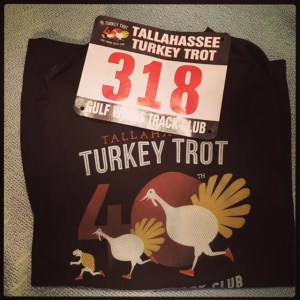
After about a month of training, I am two days away from my first 5k race. I don’t remember what inspired me to start, but I am encouraged to know that for many writers, distance running is a part of their creative process. Nick Ripatrazone explores the phenomenon in November’s Atlantic article, “Why Writers Run.” Joyce Carol Oates, for instance, “eases writer’s block with an afternoon run.” Haruki Murakami says he “became a serious writer, ‘the day [he] first went jogging.'” I’ve only just started, but I can see the connection: it involves the same clock-checking doom (it’s better done without checking a clock); it’s got the same accomplishment relief/joy of putting pages and hours into a novel. 

One thing I enjoy about introducing running into my writing life is that it dispels the myth I once believed of the unhealthy genius. In the past, my understanding of a serious writer involved a hungover, cranky artist enclosed in a small workspace, escaping to a porch or balcony to smoke through sticky sentences or plot points. Cigarette breaks were my writing process but these days, I’m able to work for longer durations without the help of any sort of substance. It took me a long while to get here, and some days are better than others (God, I miss smoking sometimes), but it’s the best way for me to persist on what I like to call “the horrible uphill climb of writing a first book.” Literally running up hills somehow equips us for literary hills, if I may drop some cheesy wordplay onto this blogpost. Pushing through discomfort and discouragement–that’s probably the thing that separates the real writers from the wannabes. Not publications, but persistence.
S for Sentence

Check out this paragraph I wrote about a Faulkner sentence. I won’t tell you how long it took me to write it, but I will say that it may be the longest time I’ve ever spent on a paragraph.

S for Sentence is a cool website where writers choose sentences to reflect upon in a short paragraph. There are a lot of cool sentences out there and on the website.

(Have a ever mentioned that I’m related to W. Faulkner? He is my great-grandmother’s cousin.  That doesn’t make his sentences any easier to write about…)

Revision Tips

I really enjoyed these from author Karen E Bender at the Story Prize blog.  #10 resonated with me the most:

Remember that revision is a process and happens in stages. The first stage, you may be trying to find out what the story is about. Then you may develop scenes, layer characters. Later, you may compress scenes/characters. Then you may work on pacing. A late revision focuses on clarity and language. You may work on any of these issues during the process, but try not to get too focused on honing the language too early, as you may not know what will remain in the story. As one writer I know says, “Writing a story is like building a boat. I don’t want to spend too much time intricately painting a hatch when I don’t know if the boat even has a rudder.”

My writing tip in general: Remember that writing takes up a lot of time.

The Seaside Writers Conference

seasideWe all know about Tin House, Sewanee, Yaddo, the Vermont Studio, and the FAWC (which I get to attend in June! Woot!), and some of us, like me a few months ago, set our sights on those places for our summers and forget about the smaller, newer and lesser known summer writing conferences and retreats.

I just got back from the Seaside Writers Conference, which was my week out with a  group of writers who workshopped stories, attended readings, and hung at the beach together. These writers were fun and helpful and not competitive, which was maybe my favorite part. The FL Gulf beach at Seaside, which also happens to be the set of The Truman Show, was beautiful enough to make me feel that twinge of “I can’t believe I get to do this” and “Why isn’t everyone here?” from time to time.

I have been writing for a decade and a half, but it hasn’t occurred to me until lately to do this kind of writer’s retreat.  I have been out of school for a couple of years and I thought I was done with workshop, as a thing, but I learned more in this week than I have in certain semesters. This is probably thanks to Matt Bondurant, who led us through each other’s stories with the right amount of tough, encouraging, and helpful feedback we all hope to get on our work.

I also got to learn how to pitch a book at a New York agent, an intimidating experience that has now been de-mystified.  Poets got to study with Seth Brady Tucker for the week, and I attended his flash-fiction talk one morning.  Like Bondurant, he is also a tremendous instructor and worth the trip.

I’m curious if any of you writers have had your own great summer writing experience somewhere else.  I can’t recommend this one enough.

Story as Experience

Some people have the notion that you read the story and then climb out of it into the meaning, but for the fiction writer himself the whole story is the meaning, because it is an experience, not an abstraction.

Flannery O’Connor, “The Nature and Aim of Fiction

Steve Almond Takes Us to Town

Most of the time, writing requires a lot of chugging along, and a lot of resistance towards hating other people.  Especially people who do well in the field.  It’s because we have this illusion that when other people get things, those things must have fallen in their laps without any effort.  Of course we know deep down this isn’t true (more likely, we resent the fact that we haven’t made the time to work as hard as other people), but this ridiculous idea translates into our own entitlement and prohibits us from enjoying other people’s work. Even when that work is really, really good.

In a recent article from Poets and Writers, Steve Almond tells the truth about how jaded we’ve become as writers.

He says,

…entitlement is the enemy of artistic progress, which requires patience and gratitude and, above all, humility. You don’t grow as a writer by writing off other people’s efforts. You grow as a writer by respecting the process.

The more we write, the more we understand how hard that process actually is. The more we write, the harder it is to write.  It’s so easy to get discouraged, and discouragement makes it hard to appreciate what other people are writing.

(I’m speaking for myself, anyway.)

Let’s just acknowledge that we’re discouraged and try not to take it out on other people.

Grace and peace to you, other hardworking writers…

Oil for the Writing Lamp

I’ve been listening to and enjoying a lot of New Yorker fiction podcasts lately. If you aren’t familiar with them, they work like this: an author who was published in the New Yorker at some point reads and discusses another author’s story, which was also published in the New Yorker at some point. Editor Deborah Treisman conducts wonderful interviews at the end of the stories. Most run about 30 minutes, which makes them great for dog walks or housework, or short commutes.  For me, these have been a post-MFA staple.

I’m sharing this one, where Jennifer Egan reads Mary Gaitskill’s story, “The Other Place,” because I can’t stop thinking about it. I’m a big fan of Egan, ever since she came to Tallahassee and I heard her discuss her writing process, which was to write out the entire novel by hand on legal pads and then craft it while she typed it up. I’ve tried this. It doesn’t work for me at all, but I love the idea. Listening to her, though, makes the writing life seem “possible,” and that is always refreshing.

The story she reads forces the reader into dark and ugly spaces (surprise! if you are familiar with Gaitskill at all…), but it does so with a wild amount of understanding and compassion.  Let me use the word “masterful” when I describe this story.  And Egan’s insights are smart.

Here are some other stories/discussions I love:

Boyle Reading Barthelme

Erdich reading Oates

Oates reading Ozick

Short Story Breakdown

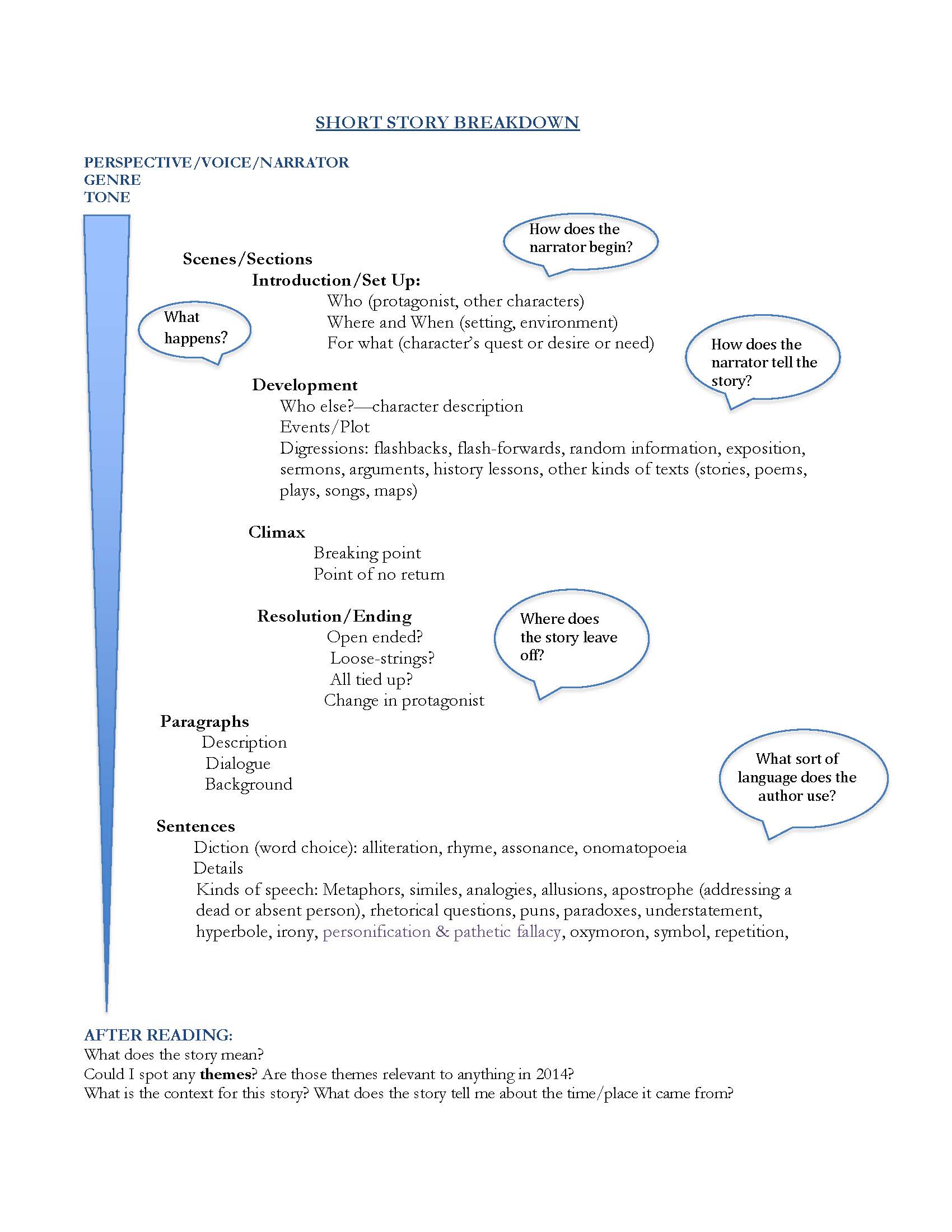
I made this when I was teaching students how to approach reading in a literature class that focused on the short story.

I am not usually a visual person, but more of an audio learner (charts make me queasy). That said, the essence of this “map” is that it starts by looking at the story in the broadest sense and moves down to the narrower, more detailed aspects of the story.    It moves from genre to structure to language.

By posting it here, I suppose I am asking what it leaves out.  Should a discussion-based literature course examine a story in a more encompassing and maybe effective way?

This is how I tend to read.  How do you read? How do you teach your students to read?

SHORT STORY BREAKDOWN

Simpsons, Sedaris, and Story Structure

I am one of the thousands of people who enjoys David Sedaris’s essays.  I have followed him since The Santaland Diaries, and think he is a great example of how to be deceptively simple.  He makes writing, particularly funny writing, look so easy.  Also, my students [usually] love it when I assign him.

I was excited to see that today, he (or his personal Facebook assistant) posted an interview from by Jenn McKee of Ann Arbor’s local online magazine, MLive.  I’m familiar with MLive (and McKee) because I went to college in Ann Arbor and later performed in at least one play she reviewed.  Anyway, all of this is to say that I was super excited to stumble upon this quote:

Q. While reading “Let’s Explore Diabetes with Owls,” I was reminded of the way your essays often start in one experience or memory, but then they end up going someplace completely unexpected. Does that association between seemingly disparate experiences just happen when you sit down to write about a topic?

A. I was listening to “This American Life” over the weekend, and on Ira’s show, they really cut to the chase. The first story was … someone saying, “This guy stabbed me when I was 18.” They get right into it. When I’m sitting down to write a story, it doesn’t occur to me to begin the story like that. For one thing – I like “The Simpsons.” Unlike most sitcoms, where you think, I bet this is the one where wife loses her wedding ring, or the husband loses his job. With “The Simpsons” – you watch the first 4-5 minutes, and you have no idea where the show is going. I like that.

I was excited because I am always using the Simpsons as a teaching example when I cover story structure.  No seriously, every time I teach a class.  But I never heard anyone else allude to its structure this way. Made my week.