Or the Whale

mobydickIt is not a coincidence that I finished Moby Dick (FINALLY) on a day when I began my day reaching for my phone and reading this. (I don’t recommend reaching for the phone while still in bed, by the way, but it’s just how this day began). I read that Daily Beast article and thought, Melville.

I am not really a Dave Ramsey person (I have reasons), but many of my friends are and his ideas have done them good, as far as they witness.  I am not even sure there is any truth to this Daily Beast article, but the idea behind the story, like the idea I read behind Moby Dick, is just true, yo.

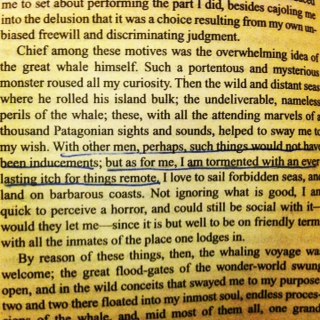
Never have I come across a book that drew such strong reactions from people. “You’re reading Moby Dick? My sister had to read that and she said it was torture,” was, in its essence, a common response when people realized what I was reading. Though I’d attempted to read it about four times, two of those times making it past the first 100 pages but then losing interest as soon as Melville started to describe the ship, I only just made it all the way through. It took me five months.*

I started it after I had to teach “Bartleby the Scrivener” to a literature class for college sophomores. I knew that the story was in some way a response to Melville’s experience with Moby Dick. I loved that story so much—its language, its mantra (“I’d prefer not to…” how true so much of the time!)—that I thought, okay, I’d better read Moby Dick now.

Again, I read this book slowly. Each chapter was like reading philosophy, not only because there is a ton of philosophy on its pages, but because the language is thick. I am not going to say I don’t understand it when people say they hate this book. It was the most difficult book I’ve ever read and the idea that high schools would assign it as summer reading material is just super crazy. But I will say that it’s sad to hear people say that they hate it, because this book is amazing. And important.

Not only is it difficult because of the language, which, at times, resembles Shakespeare in its depth and beauty; it’s difficult because of what it reveals about the impact of imperial power upon humans.

(The ship! The hearse! The second hearse!” cried Ahab from the boat; “its wood could only be American!”)

I am amazed at how well the book diagnoses the sickness of wealth and power; some call it “worldly ambition.” Of COURSE it would be unpopular; it brings the hardest truth about humanity into light: that this kind of (monomaniacal) power corrupts.   It is a sickness that all artists (and non-artists, like Dave Ramsey) battle all of the time. We want our work to bring us recognition, fame, glory—all the things that I believe Moby Dick represents. This empirical (significantly white) whale is what filmmakers call the MacGuffin. If we just have that thing, then all of our problems will go away (that book publication, that good review, that tour, that Pulitzer). Of course someone who reveals this uncomfortable truth in such a masterpiece would die poor and unpopular. Of course.

(“Oh, lonely death on lonely life! Oh, now I feel my topmost greatness lies in my topmost grief.”)

As a writer, I often ask myself if it would be better to write like Melville or to be famous and loved but forgotten? Is it better to produce the masterpiece and live poorly? Is it better to have little light while living but to leave the world (in book form) a light that will never go out?

Regardless, Moby Dick demands a reevaluation of how we live and decide what is important. Why do we want what we want? Does this thirst overpower our ability to interact with others, to acknowledge other people at all? Reading Moby Dick is a complex journey into our own darkness.

Bitterness and Writing

There is a lot of wisdom in this edition of “Fury”–VIDA’s advice column for concerned writers.  In #15, Grateful VIDA-Lovin’ Lady complains about how her MFA program didn’t prepare her for the real world.  I could sort of relate.  We go to school hoping we’ll be a bit more prepared to be a writer, and that means, have insight into how to publish.  Sometimes it seems like people are leaving us out so we won’t be successful (*seems* being the operative word here). Teachers are often hesitant to give details about this, and though the article guesses this is because teachers don’t want to be discouraging, I also think it’s because publishing has changed an awful lot since the early 90s, when many (most of my) professors were getting their MFAs.  The writer complaining about her MFA program says she’s ditched writing poetry for Children’s books, and she expresses a lot of bitterness towards her program for not better bolstering her poetry career.

VIDA responds:

…complain about them all you want  … populate forums with alarming anecdotes about your lazy teachers, but don’t stop writing. If you can give up writing poetry that easily, it was never going to be the thing you ended up doing. Writers write because they feel they must, not because they did or didn’t get a degree. Because poetry doesn’t need a time out; your feelings of resentment and frustration do! Just because you feel bitter about having wasted your time at a shitty MFA program, don’t take it out on the thing you love.

What a great reminder. I mean, why did we get degrees in the first place?

Here’s the thing about breaking into writing as a profession: there is not one path.  Listen to interviews (Bookworms, especially), and you won’t hear the same story about how writers broke through.  I asked each of my professors something about the writing profession and got widely different responses.  Why? Because, again, there is not one path.

A huge part of being a writer, and I’ve probably said this before, is figuring out what you have control over and doing your best with that small portion of your career.  Trust me, that small portion is a lot of work. Writing grants, submitting stories, working to pay for writing conferences, etc. Also, consistently trying to improve our craft.

Write your best, keep growing, and keep seeking.  Maybe I’m too much of a mystic, but I think that if we put forth the effort, our work will find a way to reach people.

The Fury writer (response from VIDA) was correct in naming luck, talent, and perseverance as the magic ingredients for a writing-success-cocktail. If you are thinking of getting an MFA, remember that nobody is going to persevere for you.  Nobody is obligated to make you famous or show you how to be famous.  If we approach our writing and careers generously, we will probably have a better chance at laying out a path to publishing.  Bitterness is probably the thing I’ve seen kill most writers.  Not a realization or feeling that they aren’t good enough, but a feeling that someone else didn’t hold up their end of the bargain.

Here’s what bitterness is: feeling bad because you didn’t get something you feel entitled to.

Here’s the way to avoid bitterness: Feel entitled to nothing.

Understand that if you’re writing because you feel entitled to have the world acknowledge your words, chances are, you’re probably not writing anything the world really needs. Write because you want to contribute to a conversation.

Ben Marcus on Reading Like a Writer

Ben Marcus say some good, practical things here in this interview from Knopf’s “Writers on Writing” series.

http://www.youtube.com/watch?v=SQokCA-Ji0U

I appreciate, especially, his reminder to write what we’d want to read.  It sounds so obvious, but it’s easy to get bogged down with irrelevant /tension-killing information while we’re in the middle of a paragraph. It’s more than just thinking about communicating to an audience when we write; it’s about choosing phrases that captivate, challenge, and entertain appropriately according to the moment we’re writing.

Marcus also draws our attention to the fact that those of us who learned to write in college/university workshops are used to having audiences that must finish our work. I’m glad he mentioned this, because I am teaching a summer college workshop at the moment and I think it’s good to keep in mind what school-habits my curriculum formulates and propels.  I’m teaching seniors, so they are about to go into the world and adjust to writing outside of the classroom.

Marcus reminded me to think about what happens when my audience becomes someone that doesn’t really like to read that much, but thought my book sounded interesting so they read the first paragraph in the bookstore?  Or before that, I’m going to have to get that first paragraph (and entire book) past an agent and hopefully editor.  The solution? I stated it yesterday but I’ll state it this way today: Learn to recognize what it is I’m reading, how it impacts me, what it can teach me about writing.

Books are the best teachers.


Writing Surprise (!)

If you’ve taken a writing class (especially one with me because I am obsessed with this idea), you’ve probably heard the Flannery O’Connor quote about how endings should be simultaneously surprising and inevitable.  Tall order? Yes.

I once heard Ira Glass speak about how important the element of surprise is in the stories he and his crew choose to air on This American Life.* I don’t remember the exact quote, just that he alerted me to the fact that writing has to be surprising, at least on some level, to sustain interest. The worst thing a friend can say after reading a draft is, “the ending was too predictable.” (Clutch my heart and fall over.)

I’m thinking about how hard it is to write surprise in stories and essays. It’s just easy (and dare I say, lazy) to be predictable in our writing.  I don’t know who said it to me, but I think surprise happens on the page when we explore options; when we don’t just go with the first idea.  Sometimes our first idea is great, but often, our second idea is even better.

This is the opposite of taking a successful standardized test, by the way, because standardized tests are the opposite of art.

Exploring options means understanding what our options are, which means reading a lot.  That is what it means to “read like a writer”–we’re picking up options, techniques, interesting ways of telling a story, from people who took those risks before us.  Often that means we have to read things twice (once for plot, once for technique).  It also means we have to read slowly, asking the question, “what is the writer doing right now with this sentence/paragraph/chapter?”

Surprise is harder to accomplish when writing creative non-fiction, because we’ve literally been there and done that and now we’re writing about it.  I’m wondering if maybe surprise in a creative essay is more about what you do with what happened–how you reflect upon the facts–than writing the facts themselves.  That is a major difference between fiction and non-fiction. The latter must not only tell a story but make meaning out of that story, and the quality of the essay, I think, has more to do with how the writer reflects than how the writer narrates.

In fiction,  we need to sit back and let our characters do surprising things, often terrible, horrible, disturbing things, but not always.  Mostly, things we don’t expect them to do but when they do them we say, “Ah. That makes sense.” Hence, inevitable surprise. Watch Mad Men or The Wire for example after great example of this.

*I take writers less seriously when they tell me they’ve never heard This American Life.  If you love storytelling then you love this show. Period. (Ha. Feeling a little sassy this morning.)