Thought for Day 11: Pay Attention.

Woodypayattention
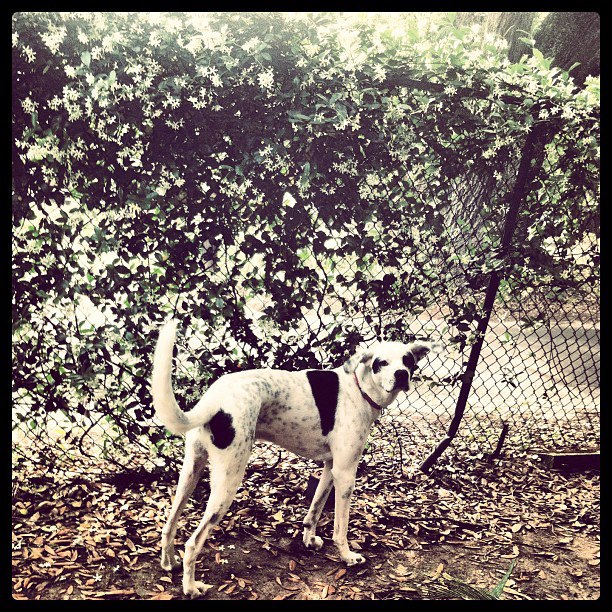
This is my dog, Woody. He’s really good at paying attention.

I just finished The Day of The Locust by Nathaniel West, which is an example of telling a story through great details  (in this case, of faux-everything-Hollywood).

Next he came to a small pond with large celluloid swans floating on it. Across one end was a bridge with a sign that read, ‘To Kamp Komfit.’  He crossed the bridge and followed a little path that ended at a Greek temple dedicated to Eros.  The god himself lay face downward  in a pile of old newspapers and bottles.

–Chapter 18, page 126.

The book is full of descriptions like this: semi-cold language with stark images to carry the emotional weight.  The protagonist (Tod Hackett) is so out of touch with his feelings. He’s got strong feelings but no clue what to do with them.  He sort of reminds me of Pete Campbell from Mad Men in that regard.   It’s descriptions like these that really get the job done in terms of portraying the amount of despair this dude actually has in his life.

Strong sense of setting is of particular importance to me in my own writing.  Stories usually come to me first, not in terms of “who” (like we’re trained, usually, to start with), but more in terms of “where.”  I get a place, and then I try and figure out who is in that place and what they want.  I cannot separate people from their places.  I am only sharing this in order to acknowledge the fact that not every writer works this way and I get that.

Even so, I think we writers can benefit from emphasizing place in our stories because in order to do that, we have to train ourselves to pay attention to our surroundings.  Paying attention is an enormous part of being a writer, of course.  Listening, we hear about often.  Watching, not so much.  Or maybe I’ve just not encountered too much from writers about the importance of being watchful. Maybe being watchful just sounds creepy? Whatev.

I have a grandmother who is a painter. She painted until she was near 90, or maybe she painted after she was 90, I can’t remember–she actually might have started up again. It’s been a long time since I’ve been home.   She is pretty awesome for a lot of reasons but one of them is that when I used to drive her places, I’d be telling her about something and then she would interrupt me to point out cloud formations, or the amount of birds hanging out the telephone wire.

Now I’ll admit, I don’t pay attention as well as she does.  I think it was Flannery O’Connor who suggested writers take drawing lessons. That is a great idea.

(Ooh! If you know me and would like to buy me a gift, I would love another copy of Drawing from the Right Side of the Brain… I left mine in Bangkok with a friend because it was too heavy to take back to Detroit.  My birthday is coming up, you know. :D)

And I think it was Natalie Goldberg who offered the following meditation for connecting to our surroundings:

While traveling–walking, driving, riding along as a passenger–pick a color, say red. Next, note all the objects you see in red.  

So simple, right? But it definitely works wonders for helping me connect to a place. I did this a few times while I was working and living in Thailand and I recommend it to anyone traveling.  It’s especially useful when you are tired of wherever you are, or homesick, or just don’t want to be in a place. It cultivates appreciation, however bland a way it seems.

This year, I came up with a point distribution game for my walks to school (I live 19 minutes away walking from the campus where I got my MFA).  It goes like this:

While traveling–walking, driving, riding along as a passenger–allot a certain amount of points to everything you notice.  For instance, the coke can you you step over on the sidewalk might be worth two points but the Porky the Pig graffiti on the side of the gas station might be worth five.  

This second game is particularly nice for getting you out of your head if you’re battling some louder-than-comfortable thoughts.

It’s my belief that cultivating this kind of awareness not only gears us up for better writing, but an overall better quality of life, too.  If nothing else, it cultivates a nice amount of mischief.

(Yes I am aware I used the word “cultivate” three times in this post. Cultivate! See, that’s five…)

Thought for Day 10: Be Transformed

Writing is scary.  If you’re a writer, you know this.  Part of the reason it’s scary is because we always feel like we have to justify why we care about our work so much.  We have to be nuts to call ourselves writers and say writing is what we choose to do. Writing is hours of work that, to everyone else, goes nowhere.  But not to us. And if we keep at it, not to everyone else, either.

Here’s another reason writing is scary: it transforms us. In order to tell a good story, we have to create characters who transform by the end and we, the writers, are transformed in the process of creating our characters’ transformations.  Our readers must transform in order to fully grasp the story we’ve told.  To transform is to change and we resist change.  We want to be comfortable.  We want security.  We must resist these desires if we want to write down the masterpieces we’ve got spinning through our thoughts.  Writing makes us uncomfortable, if we’re doing it right, because we grow and change during our writing practice.

When we sit down to write, we have to be open to transformation.  We’ll never be the same as we were in those moments before we sat down to write.  But writing is good.  Change is good.  This transformation, ultimately, is the best thing our writing can offer us.

Thought for Day 7 of Revise the Novel Month: Selfless Ambition.

One of the most haunting quotes of all time for me is one Thom Yorke (of Radiohead) sings in “Paranoid Android”: Ambition makes you look pretty ugly.  Haunting and scary.  I don’t want to be ugly. I want to be pretty all the time. I also want to be ambitious. Actually, I can’t help but be ambitious.  I have a drive and I hate feeling like I’m in a lull.  A good friend used to tell me all the time that I have a motor. It’s true: I have a motor.  I suspect that if you call yourself a writer, part of that is because you have a motor, too.

Today I spent an hour doing an exercise in Julia Cameron’s THE RIGHT TO WRITE, where she recommends that you put on music that makes you feel adventurous (for me this was the Soundtrack to Amelie and a bunch of Elmore James, who makes me wiggle in a good way–I’m wiggling as I write this…).  Then you take ten minutes dreaming on the page about six areas of your life: Spirituality, Friendships, Living Space, Traveling/Adventure, Work Life, and Creative Projects.  All of this writing helped me come up to today’s thought:

There are two kinds of ambition: selfish ambition and selfless ambition.

Ambition is good.  It can’t be helped for some of us.  Some of us just have motors (and we remain ever envious of those who are content with simple lives).  I recognize my motor and I embrace it.  It’s what’s going to get me through this novel.  But I must make a choice as I go to work, as I let the motor propel my writing: I must choose selfless, over selfish ambition.

Selfish ambition means I want to be number one and I get pissed off when others pass me in the race to success. I shun the friends who are rewarded for their hard work.  I am angry because I deserved whatever reward they received–I am entitled to whatever they got.  I am bitter and I am depressed because everyone is passing me by.  I am stuck in despair over other people’s achievements.

Selfless ambition means I want my success to inspire people to strive for their own successes.  This means I live in constant congratulatory mode.  When my friends make achievements, I congratulate them.  I celebrate their success.  We are all on a team to make the world better.  We want our friends to produce the kind of work that delights and satisfies, that inspires readers/listeners/audience members to appreciate their lives, to stay curious.  We want our friends to put good writing out there and for that good writing to be recognized and appreciated.  We want our friends to be rewarded for their hard work.

Selfish ambition means I write only to satisfy myself.  I write for paychecks. I write for recognition. I write for revenge–everyone who overlooked my work will feel like the jackass they are when they see how fabulous my work has been all along.  I write to make people suffer while I work my way up the ladder.  I write with a hunger that will never be satisfied, though I convince myself that if I just have a book published, if I just get a tenure track job, then I will be satisfied.  I crush everyone along the way to these goals.

Selfless ambition means that I write in order to enlighten the world to whatever topics, people, and phenomenons that I discover during my writing process.  Ultimately, our creative projects are good for us and they are good for everyone else.  When people overlook my work, I work harder and do not despair.

I choose selfless ambition over selfish ambition because, I believe, it’s an answer to Thom Yorke’s observation in this here quote:

Recommended Reading: The Right to Write by Julia Cameron, Penguin: 1998

Cinco de the Thoughts for Revise the Novel Month: Forget Failure.

I’m going to name drop here, so watch out: Alan Shapiro once said in a sprint course I took with him at Miami of Ohio that you have to accept failure as a part of being a writer. You can’t be afraid to fail because you will. It’s just going to happen.

This is great advice but I’m not going to stop at that. I’m about to one-up that one-of-the-greatest-poets-and-writers-who-ever-lived and say, “Forget failure.”

Tell yourself that failure doesn’t exist.  This brings me to another name-drop, actor and director, John Neville Andrews, from whom I took Acting as a Profession course at the University of Michigan.  John said once, and this is one of my favorite quotes of all time, “You will not fail on stage. You might f*ck up, but you will not fail.” Now read that again in a British accent.

He might have said “make a mistake” instead of fail.  The point is this: you are an artist. If you’re making stuff, you have already won. (Have a beer! AFTER you’ve clocked in your writing time…) When you’ve made a mistake, you have not failed, but you have had a revelation.  You’ve taken a step.  You are one step closer to the finish line because you know something you didn’t know before.

You can’t give up every time you make a mistake, no matter how much you feel like you’ve failed.  You haven’t failed, so just keep running the marathon, baby.  Your novel is a marathon.

With that, I leave you with two U2 references. I understand that there is a chance that you hate U2, but bear with me here. The first is another one of the greatest quotes of all time (in one of my least favorite of their songs): “There’s no failure here, sweetheart, only when you quit.”

I love it when Bono calls me sweetheart. I also love it when he proves, like he does here, that he is one of the smartest fellas who ever lived.

The second is an entire song.  I listen to it every time I feel like I failed.  I haven’t failed.  I’m one step closer.

Fourth Day Thought: Leave Your Problems at the Door

Before I had writing, theater was my creative outlet.  Today’s thought comes from those days, they seem long ago now, when I used to be an actress. Here’s what I learned: when you’re in a show, especially when you’re in rehearsal (which is the creative period for an actor–you’re creating a character while you run your scenes with the other actors), it’s really important that you leave your problems outside of the rehearsal room.

I recommend having a room especially dedicated to writing—a room where you do nothing else but write.  I understand that many of us don’t have this; I only got mine in the past year and that was by a huge stroke of fortune. I might not always have this space, either.  For those of without a room to spare, I recommend having some sort of writing space. If you write at a coffee shop or a library, leave your problems at the entrance. If you write on your porch, leave your problems inside the house. If you write on your couch, leave your problems on the other side of the room before you sit down. Decide that you are putting your problems aside as you start to write.

Problems might include bills you forgot to pay, or a fight you had with your sibling, or whether or not you should call that dude back, or the fact that your dog needs a walk.  In your writing space, you’re going to need to concentrate on the character you’re creating.  You’re going to need to take on the mind of your character.  This is fantastic if you’re like me, a bit of an escapist, and you like to escape from your problems for a while.  Writing is the time to do it. (Especially when your protagonist is an escape artist, like my protagonist is an escape artist–ha!)

When I go into the extra bedroom I’ve dedicated as my writing room (the office), I try to imagine that when I go into that space, I have a different identity.  I’m still Nora, but I’m Nora the Writer.  Nora the Writer doesn’t care about bills or other people who she’s not writing about while she’s working on her fiction.

Sounds kind of harsh? Well, my friend, writing does require a certain degree of ruthlessness. Even so, you might consider taking care of your problems before you go into your writing space, that way you won’t need to think about how you owe so and so an apology while you’re trying to write a scene that has nothing to do with so and so.

Now, you may decide to tackle a specific problem with your writing—you might work something out in an essay or a poem.  Cool. That’s not really what I’m talking about. I’m talking about leaving behind anything in your mind unrelated to your writing.  Pay your bills. Answer your emails. Walk the dog. Call so and so back before you go into your writing space.  That, or commit to dealing with it later—decide on a specific time when you will stop writing and deal with that stuff.  Deal with that stuff outside of your writing space.

Thought for Day Two: Endurance

A woman in my apartment complex told me she has a novel idea.  I’m sure she’s not the last person who will ever tell me that. I heard this girl at the airport once go nuts over her novel idea. She annoyed the hell out of me, this airport girl.  I wanted to interrupt her and say, “You have no idea what you are talking about.”  But you know, maybe she did?  Maybe her novel will come to be and maybe it will be a great novel.

In the book I recommended yesterday, The War of Art, Steven Pressfield spends a section of tiny essays explaining what makes a writer (or anyone) a professional. One such essay is called, “A Professional is Patient.”  On page 75 he says that the professional,

 … understands delayed gratification. He is the ant, not the grasshopper; the tortoise, not the hare.  …  He knows that any job, whether it’s a novel or a kitchen remodel, takes twice as long as he thinks and costs twice as much.  He accepts that.  He recognizes it as reality.

The reality is, I think, that most of us have novel ideas, or just really good ideas in general that will take a lot of persistance to make them materialize.  Some of us have entire drafts of those novel ideas but what separates those who actually follow through with those ideas from those who won’t–any good idea, says Pressfield–is the acceptance of delayed gratification.  Every day we must go to work and say, I’m going to take my time. I’m going to keep working until this is done.  And then I am going to keep working on it again until it is great.

So, today, on this second day of RTNM, I am going to slow down, take my time, and do my best to get lost in that work.  It’s that whole cliche about recognizing the value of the experience in the journey, not the destination.

Anthologized

The Chicago Center for Literature and Photography (CLAPP) recently anthologized story of mine called Uncle Sam City” in this book:

It’s a collection of short stories that emphasize setting; the story I wrote was set in Bangkok, Thailand.  Other authors collected include two author-friends of mine from my time in Oxford, Ohio: David Harris Ebenbach, who was, for a short time, a local writer in those parts and Joseph Bates, a resident writer at Miami University who taught one of my grad seminars there.  He was actually the first to workshop “Uncle Sam City,” when I submitted it as “untitled”.  It’s gone through several changes since then.  I’m really honored to be in a book with these two–they are wonderful, imaginative writers and fantastic folks.

Other authors in the collection who I don’t know include:

Jenn Winter, Brandon Tietz, Dan Treadway, Robert Duffer, Heather Skyler, Elva Maxine Beach,  Delphine Pontvieux, Emma Riehle Bohmann and Lorraine Boissoneault.  Traci Kim is the editor.

For information about how to access the collection see this page on the CLAPP Center’s website.

another old writer (i’m newly obsessed with)

Toni Morrison is 80.  She published her first book at 39.

I’m taking a ton of summer classes (by ton I mean three) and for two of them I had to read Toni Morrison novels–A Mercy and The Bluest Eye.  I’ve sort of bookended her career, I suppose.  Now I’m tearing through Beloved on the side of all my homework (i.e. write four response essays and read two other novels by Wednesday…) and I think it might very well be the best book I’ve ever read.

I love that I can go through nearly two decades of school (counting kindergarten) and still pick up new writers to be obsessed with.  This reminds me of why I think it’s silly for writers to be competitive–sure, our own success and glory is pretty great, but isn’t it also great to read good books?  Don’t you want publishers to release as many good books as they possibly can? Don’t you want the people who write these good books to be your friends?

I will probably never “know” Toni Morrison, but for the record, she did recently appear to me in a dream wherein we were going out for pizza and bowling and she was really nice. And now that I’ve transitioned back to the main subject of this post, I am going to say, once again, that we can learn from writers like her that there is no need to rush our writing careers or put pressure on ourselves about how much we should have published by when.  Just write well, live a long time, and write a lot.  And read Beloved if you haven’t yet.

should aspiring writers go to grad school?

If you have read my about page you can probably predict that I tend to answer this question with an enthusiastic yes.  Here’s why:

student writers have to write a lot

they have to read a lot

get to talk with someone about writing at least four times a week

meet established writers

go to readings all the time

get exposure (and perhaps funding) to go to writing conferences

get really good at reading other people’s work

if they teach or tutor, get really good at line editing and spotting errors

All of that said, I followed some advice coming out of undergrad that I should take some years off before applying to an MFA program.  I took four years; I spent two in Detroit and two in Bangkok.  This decision worked out really well for me because I was exposed to tons of communities in a short amount of time. I worked as a nanny, an actor, a musician, a research assistant, a tutor.  I stocked a department store, directed radio-performances for the blind with a cast of senior citizen actors, traveled to South Africa, India, Vietnam, and to every region in Thailand.  I picked up a lot of cool anecdotes on the way and I am curious about a lot more things than I was before I met all the people from those experiences.

In both of my graduate programs for creative writing, I’ve had friends and colleagues  who have come straight out of undergrad.  Some of them probably could have benefitted from exposure to life experiences outside of the academy but some are spectacular writers and write about cool stuff.  It really depends on the person.

In my experience, street-cred made me a more rounded writer, but school made me a better writer.  I think anyone can get tons of life experience and still be a terrible writer because, if they are anything like I was, they weren’t sure how to send their stuff out, what to read, who to talk to. There are ways to find this stuff out but, if they are anything like I was, will have a much harder time outside of academia.  Whatever the case may be, I have a hard time believing someone could go to graduate school, work hard (this is key), and come out at the same level they went in.

I will end this post by saying that I initially wanted to go to grad school so I could work in the academy and be a writer.  I’m more skeptical about this now–about my ability to land an academic job with an MFA.  The market for the writer academics who inspired me to write in the first place is totally different than the market will be for me.  I still don’t regret spending all this time in school.  Writing is the only thing I know I’ll be doing three years from now. Regardless of what I do–whether it’s getting more street cred or adjuncting or whatever, I’ll be able to write better than if I hadn’t been a student.