It’s the 9th! 9 can be divided by 3. We’re writing a song today, is what I’m saying.
TODAY’S PROMPT: Take a well-known character, historical (real) or fictional (fabricated), and reference him or her in a song.
You can choose the point of view. You can write a first-person song, where “I” is the subject, from your own perspective or the perspective of the character. Like the Johnny Appleseed song, “The Lord is Good to me…”
You can write a song to the character, so that the character is “you” (second person).
You can do what Bruce Springsteen does with the Ghost of Tom Joad, and retell the person’s story in the third person.
Famous examples include:
John Henry & The Battle of Davy Crockett (Traditional)
Candle in the Wind (by Elton John was originally about Marilyn Monroe but got re-appropriated Princess Diana).
Kryptonite (Three Doors Down. Remember? From like 1997?)
Sam Cooke has songs about two of my favorite Bible ladies: the woman at the well (Jesus Gave Me Water) and the bleeding woman who gets healed by touching Jesus’s clothes in a crowd (Hem of His Garment).
Drunken Ira Hayes (Johnny Cash).
Buffalo Bill (Jeff Wilkinson).
Hurricane (Bob Dylan).
Wonderful (is about Stevie Wonder by India Arie).
Sabu (The Elephant Boy–by John Prine).
*Special thanks to my dad for helping me come up with these examples.
TODAY’S PROMPT: take an old poem, without a copyright, and put a tune to it.
Rhyming is so out of poetry-style these days that if you can find a poem that rhymes, you’re likely to be safe. But just in case the song you half-create today is amazing enough to hit the airwaves and/or you just want to be careful, here is a website of poems in the public domain. It’s not hugely expansive, but it’ll get you started. Also, the site has nine Oscar Wilde poems on it. I didn’t even know he wrote poems. Doh.
Give it a shot!
SONG OF THE DAY: Richard Cory
Paul Simon is a poetry buff, if you haven’t noticed. He’s one of the most poetic lyricists we’ve got. This song, from his Garfunkel days, springs out of a poem by Edwin Arlington Robinson by the same title. Read the poem and you can see that S&G took a lot of liberty, i.e. rewrote and updated it. You can do this, too! You can do anything and everything you want to interpret and own the poem you’re working with.
RICHARD CORY
Whenever Richard Cory went down town,
We people on the pavement looked at him:
He was a gentleman from sole to crown,
Clean favored, and imperially slim.
And he was always quietly arrayed,
And he was always human when he talked;
But still he fluttered pulses when he said,
‘Good-morning,’ and he glittered when he walked.
And he was rich – yes, richer than a king –
And admirably schooled in every grace:
In fine, we thought that he was everything
To make us wish that we were in his place.
So on we worked, and waited for the light,
And went without the meat, and cursed the bread;
And Richard Cory, one calm summer night,
Went home and put a bullet through his head.
TODAY’S PROMPT: Learn a song in a style that you’re not too familiar with.
I’m about to learn a reggae song today, I think. I know none, so it’s going be a challenge. What does Nora sound like singing reggae? Time will tell! At the very least, it will be a chance to learn a new strumming pattern.
I’m very interested in the styles that people choose, if they choose to do this prompt.
SONG OF THE DAY: Vietnam
My brother is a huge Jimmy Cliff fan and he put this song on a compilation CD he made for me while I was living and working in Thailand. Music in English that wasn’t terribly popular, or at least, world famous, was hard to find in Bangkok. My friends and brother knew this and sent me a lot of music while I was there. This was before I had iTunes. I still listen to the majority of that era’s tunes (I learned to love Lucinda Williams during that time!), and this Jimmy Cliff song is no exception.
Wikipedia says that a ballad is a narrative set to music. By that definition, you could have the prompt be simply “Tell a story in a song.”
Before the 19th Century (I’m getting most of my info from the wiki site!), ballads were, as I mentioned in a previous post, a form of HBO-type entertainment. They spread news stories across oceans, they compelled listeners with riveting suspense.
In the 19th Century, the definition of a ballad became “a slow popular love song.”
So, write a narrative song or a slow popular love song. Up to you! This month is totally your oyster.
I’m going to be working with traditional ballads today, though, because those are some of my favorite songs to sing and write. I have a special fondness for new music that sounds old. (This is why the band Over the Rhine tends to be my favorite.)
If you too want to be traditional, make sure you kill someone off in your story and structure the lyrical rhythm to go a little something like this:
BaDAH baDAH baDAH BaDAH
BaDAH baDAH baDAH
BaDAH baDAH baDAH BaDAH
BaDAH baDAH baDAH
And try to have no less than six verses. The longer it is, the more impressive it is until it gets too long. But the longer you can hold the audience’s attention with suspense, the higher quality the ballad.
Here’s another challenger: the refrain, in a good ballad, changes meaning in context of the verses.
News stories make good ballads. Deaths (as previously stated) make good ballads. Lost love makes good ballads too. Keep it dark, people.
Or don’t. If you’re not dark and you have no fascination for the old-timey, do this assignment the post-19th Century way and write yourself a powerful (slow) love song.
SONG OF THE DAY: Boots of Spanish Leather
Bob Dylan loved him some ballads. Here’s one that Norton anthologized as one of the greatest poems of all time.
If you know me at all you knew this day was coming.
PROMPT: Learn a blues song.
The blues ranges in difficulty from three really simple chords to hot damn. It’s also got a lot more diversity in styles than people tend to realize.
We normally think that blues songs are all sad but trust me, they aren’t. Have you heard BB King’s version of the “Catfish” song, for instance? Or Taj Mahal’s “Cakewalk into Town”? Then there is the gospel blues. The Holmes Brothers own this style, I think, though Eric Bibb plays my favorite songs–these are gospel songs in the blues style. They are about ugliness and redemption and they are awesome.
Here is my favorite gospel blues song:
I like the porch blues the best—I guess that’s officially called Delta Blues? I like Mississippi John Hurt’s style. And Leadbelly’s. If you like Muddy Waters and Buddy Guy, that means you like Chicago Blues–less rustic, more showy. My favorite blues singer, Elmore James, plays both Delta and Chicago.
I first came to love the blues about a decade ago when, in that fair time when Borders was still alive and well and in Ann Arbor, I decided to spend an afternoon listening to CDs they had on display. Remember when we could do that? Le sigh. Anyway, that was the day I first listened to The Very Best of Elmore James—he had me at the first squeal of his slide guitar in “Dust My Broom”. I melted. I bought the CD. I have been obsessed with the blues ever since.
The blues has a lot to teach us about honesty, self-awareness, grit, and, ultimately, joy. I get a tremendously joyous feeling when I listen to the blues. I’m hoping to pass some of the joy on today with the prompt.
Okay, so …
If you don’t know any blues chords, this site might help you get started. There are plenty of people all over the internet who would love to teach you how to blues out. Youtube has several instructional videos about this. Just google “How to play the blues.”
SONG OF THE DAY: I’m Bad Like Jesse James
John Lee Hooker is a Detroit bluesman. His songs are violent/sexy. He growls a lot, is what I mean. He is my second favorite blues musician, next to Elmore James.
Originally my prompt was going to be “Learn a Beatles song,” which is probably how I will approach this assignment, but then I decided to open it up a bit. Though I think hating the Beatles is silly (it’s like refusing to read Harry Potter–not a real aversion to the books, just an aversion to what’s “popular”), I wanted the prompt to appeal to Beatles-haters, too. (My version of crowd-pleasing.) Also, to get more at the essence of what I want to gain from the prompt itself.
Okay, so playing songs that other people might a) be able to sing along with, b) recognize, and/or c) request is not my strong point as a musician. I have a green notebook that serves as a song archive. (It now has a songwriting month section–hurray!) I bring this book to jam sessions or singalongs and stuff and then realize, again, that I tend to learn how to play songs that nobody has ever heard.
The most “known” song in the book might be “Shot in the Arm” by Wilco.
Actually, it’s “God Rest Ye Merry Gentlemen” and “What Child Is This?” Not songs people are requesting most months of the year.
(Oh wait–I just remembered that recently, I learned “Let’s Give ‘Em Something to Talk About” for a fundraising event, but before that the most popular song in my book was “Shot in the Arm,” or a few Radiohead songs, or whatever. You get my point.)
This is the Woody Guthrie in me speaking, but I believe music, in general is meant to be a communal experience. We’re not learning to play all these songs so we can sit in our rooms and listen to ourselves sing (though I will be doing a lot of that this month). It’s a good thing to create songs and learn songs with the purpose of sharing them. For instance, my friend Laura, who is also musician/fiction writer (there are a few of us!), sings and plays Destiny’s Child’s “Jumpin’ Jumpin” on the guitar. It’s funny but more importantly, it is fun. She does this for the sole purpose of making other people happy (also, perhaps, for letting the world see how awesome she is).
So, today learn a song that you know will please a large group of people–not just yourself.
SONG OF THE DAY: Dusbowl Refugee
Since I mentioned him, I’m sharing a Woody Guthrie song that he wrote to delight and connect to a specific crowd. That’s his whole life, by the way–he wrote songs to lift up people. It’s why I tend to refer to him as “Saint Woody.”
Happy Songwriting month! Are you ready to write a song now?
We’re going to be writing a new song every three days so that we can come out of this adventure with 10 new songs.
Intimidated? I get it, so am I, but we can do it. Remember, the songs don’t have to be brilliant, just workable. We have all month and then the rest of our lives to make the song spectacular.
TODAY’S PROMPT: Write a sonnet and put a tune to it.
It’s okay if you don’t know or remember how a sonnet works because I’m about to tell you.
It’s simple: The only rule is it has to be 14 lines. In a song, that’s probably going to look like three verses and a rhyming couplet at the end.
You can go Shakespearean on the rhyme scheme:
ABAB
CDCD
EFEF
GG
Or Petrarchan:
ABBA
CDDC
EFFE
GG
Or you can do whatever you want! The only rule is that it has to be 14 lines.
You can be super formulaic and write each line in iambic pentameter, but in my experience, ten syllable lines sound terrible in songs. (Yes, I have tried to fit iambic pentameter in a lyric line before. Have I mentioned that I’m a nerd?)
One thing you might try, which works wonders in getting the song to move, is to try the traditional sonnet form for subject/verse relationship. It goes something like this:
Verse one makes a statement or proposes a problem.
Verse two develops that statement or problem.
Verse Three counters the statement, or tosses a curve-ball into what you’re developing.
The end, or rhyming couplet somehow brings conclusion to the problem you’ve set up.
Have a go!
SONG OF THE DAY: Ol’ 55
This song has nothing to do with sonnets. It’s the first Tom Waits song I ever loved. The real reason I’m choosing it is because I’m hitting the road real early this morning to embark on a long drive home. It is the world’s best song for an early morning’s drive.
By the way, someone posted the whole Closing Time album on Youtube and that’s what I’ve posted. Listen to the whole thing! It’s so good. And sexy. Young Tom Waits is actually sexy.
He’s also a poet, which makes him appropriate for sonnet day.
Once upon a time (hey nonny), I took a rhetoric of song class at Miami of Ohio that alerted me to the fact that our music history (“our” as in “American”) is chock full of songs that tell really dark, complicated stories. Ballads are the HBO dramas of the past. We’ve got songs about infanticide (“The Cruel Mother”), songs about murder guilt (“Edward”). “Mary Hamilton” is a first person account of a woman waiting for public death because she got pregnant by the king and killed the baby. Dark stuff, yo. And really dramatic.
Not all the old songs are dark. Some of them are about feeling like mack-daddies in a world gone right (“Sittin’ on Top of the World”). These songs came from overseas and morphed on American soil; their journeys help us understand where we came from and maybe where we’re going.
All the cool kids are doing it, by the way.
Everybody who is anybody knows how to play “Saint James Infirmary.” I mean, I have my version. So does Janis Joplin, despite the fact that Louie Armstrong is probably the true owner.
Gillian Welch has a fantastic “Make Me Down a Pallet on your Floor.”
These songs are great because you can play them in any setting and not worry about copyrights. Right?
TODAY’S SONG: “I Wish My Baby Was Born”
I learned about this song in my aforementioned rhetoric of song class. There’s a great version on the COLD MOUNTAIN soundtrack.
This one isn’t Jack White (who is fantastic all over that soundtrack), but it does have the potential to destroy a listener:
Lyrics:
I wish, I wish my baby was born
And sitting on its papa’s knee
And me, poor girl
And me, poor girl, were dead and gone
And the green grass growing o’er my feet
I ain’t ahead, nor never will be
Till the sweet apple grows
On a sour apple tree
But still I hope, But still I hope the time will come
When you and I shall be as one
I wish, I wish my love had died
And sent his soul to wander free
Then we might meet where ravens fly
Let our poor bodies rest in peace
The owl, the owl
Is a lonely bird
It chills my heart
With dread and terror
That someone’s blood
There on his wing
That someone’s blood
There on his feathers.
I have been waiting for this month since April, when I came up with the idea. I am so excited about it, that I actually wrote this post the night before.
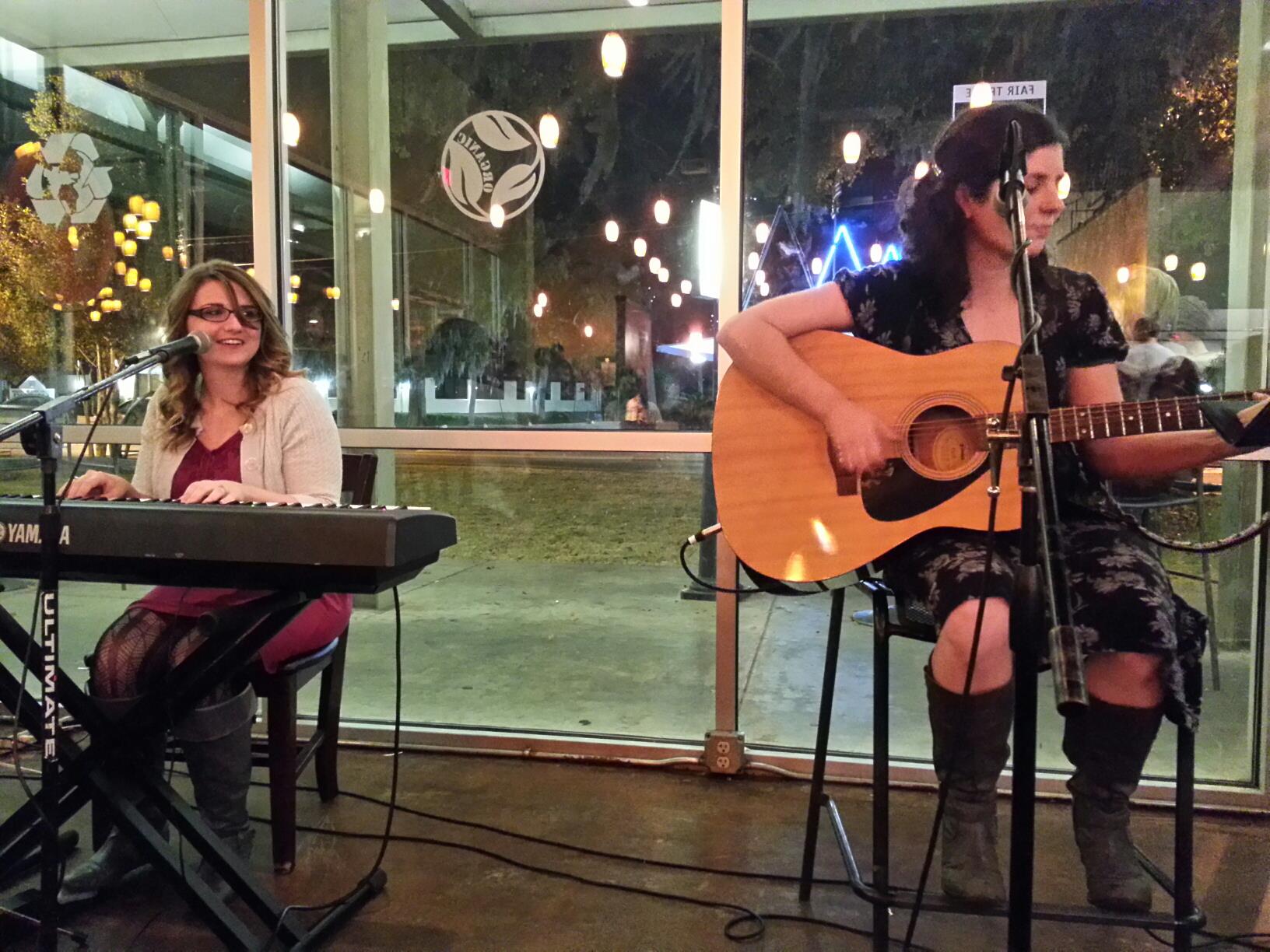
asked me how she can participate if she’s a piano player? This is a good point. I play the guitar (see in the picture? I’m the giant with the guitar…) so I will be writing/learning songs on that. But I really hope Lindsay participates (because two are better than one, of course), so here’s my answer:
Write songs for the piano!
Or whatever instrument you play. My friend Paul rocks the melodica (besides the piano). I say, if you play the melodica, this month can be for you too. And you too, recorder/trumpet/flute players. It might be harder for you drummers. Basically, just try to learn a song a day. On days where I give a songwriting prompt, write a song that goes well with your instrument?
Okay, so here’s how I’m hopefully going to go about posts this month. Each entry will have one prompt and one song of the day with some thoughts about the significance of that song. They may or may not be related.
PROMPT FOR DAY ONE: Learn an old hymn.
Not a contemporary (Christian) song. An old hymn.
Now, I understand if you are one of those folks who gets all squeamish at the idea of anything that has to do with your corrupt church experience. If this is the case, you might get a similar experience out of choosing some song to learn that inspires some sort of feeling of transcendence for you. More props for you if you can find an old song that makes you feel this way.
Because Salman Rushdie told Bill Moyers that, “All art began as religious art.” I don’t know if Rushdie is right but it makes sense if he is. Music is mysterious. It invokes (in me, at least) ideas of the supernatural.
And so, songwriting month begins with a religious song. These are usually songs that have lasted centuries and often come from crazy deep places. You might want to investigate the story from where your hymn came. Most of them have Wikipedia pages, I think. There are lots of people on the internet obsessed with old hymns and their stories.
There are hymns all over the Internet. Choose one for any reason at all: because it’s pretty, because it hits you as somehow true, because the words are hilarious and gory (there is a lot of blood in hymns– fountains of blood in hymns), because it was your grandma’s favorite, because you’ve never heard it before and it has a cool title. Figure out how to plunk it away on the guitar.
SONG OF THE DAY: In the Garden
I love this Willie Nelson version.
Here’s why I chose this song:
1. It brings back memories of my performing arts high school in Detroit, when a group of students competed in a speech/drama competition with an eight-person version of the play, Rimers of Eldrich. This is a tremendously creepy play about a corrupt little town, and there is nothing like a group of city kids trying to pull it off (and they pulled it off well, if I recall). They returned to this song throughout, as a sort of motif. It was totally creepy. Now the song has a sort of creepy-awesome connotation in my mind, and so I like that complexity. (Don’t worry, I am fully aware of how weird I am.)
2. My mom sings hymns every week with residents at a local Detroit nursing home and this is one they sing together. I love to hear the old folks singing this song. No matter where I am, they seem to be singing, I can get to the garden with Him. From an inner city Detroit nursing home, that shit is inspirational if nothing else is.
Recommended Listening: “My Mother’s Hymn Book” ~ Johnny Cash
Whoa–what a month it’s been. Besides trying to understand what it means to be a writer, I also found myself embarking on a serious self-improvement overhaul. That’s why so many of my thoughts are life-thoughts.
Writing is a life. It’s a lifestyle. It filters into every other aspect of who we are. It’s an identity–it provides a certain perspective on the world around us. Hopefully, it provides a more generous attitude towards others and ourselves; hopefully it keeps us curious and non-judgmental. It definitely keeps us disciplined. It keeps us persistent, a little ambitious, and resilient towards the things that seem to want to try and steal that identity away from us.
I highly recommend these month-long projects, which I’m now just starting to embark upon. Here’s a bit of reflection on the experience:
I tend to make goals for the distant future, but by keeping the month in mind, I found myself more focused on keeping the daily routine. I didn’t work on my novel every day (in fact, I deliberately took Sundays off from it), but by knowing I was in May, and that May was Revise the Novel Month, I had an easier time keeping a clear goal in mind. For me, it was shape the thing up to send to manuscript clearance for the MFA and to send it off to a few friends for the next time I dedicate a month to the novel. I did this, but it was a severely bumpy ride. I had drama to deal with (which is why you got a post about it, of course), I had a lot of self-doubt and days of flat out laziness.
It’s not done. (I didn’t expect it to be.) There are many months of work to come; as many as it will take to see this thing come to a place that feels ready to send off to agents and publishers. I plan to keep on dividing the work into month-long projects. I might spend a near-approaching month on character development, for instance, with short exploratory assignments. I might spend the month writing scenes that may or may not go into the novel. I might then spend another month shaping the first fifty pages, or the first act, or however this project unfolds. My routine is going to change drastically because I won’t have as much time once I start working again in the real world. This scares me, but I think the monthly plan is going to be a huge asset.
If you do the monthly project thing, I highly recommend you start with poems. They don’t have to be good (mine weren’t especially). But they are manageable and they help us to think more deeply about words. And I found myself continuing to write poems, even through revise the novel month. They are, at their most base state, a fantastic verbal exercise for the prose writer.
My next project is to take a bit of a break from the novel in order to work on music. I did this in April, when I focused on poetry and language. I think that the month off definitely helped me in terms of filling the well with energy and willingness to work on the book. By the end of April, I couldn’t wait to hang with my characters again. Hopefully this will be a repeated experience.
My last thought: You can do it. If you’re writing a novel, you have to keep reminding yourself that. It’s hard, but you can do it. You have everything you need to do it well.


 Nora Bonner